Dr Gómez
Hot MilkDr Gómez is an orthopaedic consultant whose care of Rose Papastergiadis unsettles the assumption that medicine must explain an inability to walk before it can address the problem. At the Gómez Clinic near Carboneras, he investigates her physical condition while asking why her capacity to walk comes and goes. He also redirects Sofia Papastergiadis’s attention from administering her mother’s medication toward making a life of her own. His authority is real, but so are its limits: the case remains puzzling, and he eventually admits he may not be able to help.
Identity and First Impressions
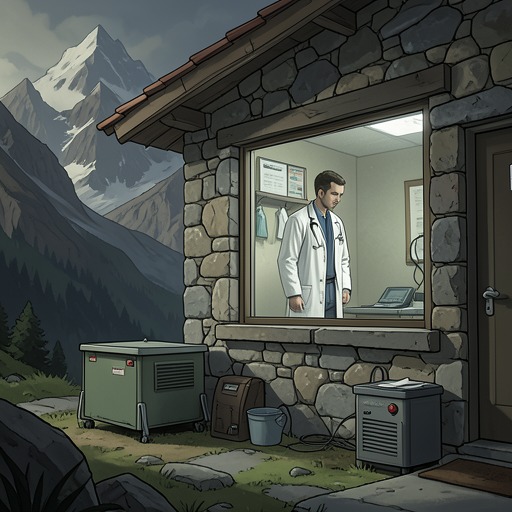
Dr Gómez is the consultant whom Sofia has researched for months before bringing Rose Papastergiadis to the clinic. He appears to be in his early sixties, with mostly silver hair marked by a striking white streak, alert blue eyes, tanned hands, and a pinstripe suit. His manner is at once authoritative and eccentric. He calls a nurse by a sunny nickname, follows a Spanish radio broadcast about the austerity programme during a consultation, and identifies the financial analyst speaking on air. When Rose is surprised by this interruption, his gold teeth add to the impression that he is not the conventional, narrowly focused doctor she expected.
He is attentive to ordinary needs as well as formal examination. When Rose asks for water, he gets it himself in a plastic cup. He also tells her that, as a consultant, his formal title is Mr Gómez, though he will not be offended by a less formal way of addressing him. These small choices complicate the distance of medical authority: he is a specialist who can direct the encounter, but he also makes himself present through practical gestures and an idiosyncratic conversational style.
Investigating Rose’s Mobility
Dr Gómez’s central question is not simply why Rose Papastergiadis cannot walk, but why she can sometimes walk. He wants to get to know her case and tells Sofia that the staff will collect Rose from the beach apartment each day, while Sofia is free to do as she pleases except on Tuesdays, when he will call her in as Rose’s next of kin. At lunch, he asks Sofia to remain silent and trust his judgment, so that he can speak with Rose without her daughter answering for her. The arrangement gives Rose space in the consultation while keeping Sofia involved in decisions about her care.
His examination attends to concrete bodily evidence. He identifies small, slightly infected ulcers on the sole of Rose’s right foot and says they must be treated immediately. He also arranges investigations of bone health, especially the spine, hips, and forearms. After Rose trips on the way to a restaurant without straining, spraining, or fracturing anything, he treats the incident as significant evidence: he says osteoporosis can be ruled out on that observation alone. What concerns him is the vitality Rose puts into not walking. The distinction does not solve the mystery, but it changes the question from a general incapacity to a fluctuation that demands explanation.
Later, an X-ray shows that Rose is losing bone density, but Dr Gómez describes the decline as normal for women over fifty and says she has not suffered a significant loss of bone material. He folds his arms in his pinstripe sleeves and suggests she walk home. His recommendation follows the findings he has just described, yet it also lands amid a case that has not yielded a stable account of Rose’s limitations. Dr Gómez does not claim that the X-ray explains everything; his examination narrows one line of inquiry without resolving the broader problem.
Medication, Care, and Clinical Limits
Dr Gómez wants to review Rose’s medication with her, asking which medicines she feels attached to and which she can let go. This makes treatment more than a list of prescriptions: it brings Rose’s own relation to the drugs into the consultation. Later, he tells Sofia that the medication routine has been erased from both their lives and argues that Sofia has become so used to administering her mother’s medicines that stopping them may feel like coming off medication herself. He interprets the caregiving ritual as a shield that has protected Sofia from making a life of her own, and insists that she will have to invent another ritual. His words shift the clinical focus from Rose’s body to the structure of care surrounding it.
That confidence does not mean he claims mastery over pain. Rose reports that Dr Gómez knows very little about chronic pain and has told her that her pain has not yet yielded its secrets. She says that he regards the pain as magnifying every day, while her feet are numb rather than hurting. The account sits uneasily beside his role as consultant: he can examine, investigate, and question medication, but the patient’s description of pain remains beyond a settled explanation.
The limits become especially concrete when Rose is admitted to hospital for two nights with dehydration and receives intravenous saline. Dr Gómez explains at a review that Rose cannot easily swallow water and therefore cannot easily swallow her medication. Hydration is not a secondary matter here; it affects whether treatment can be taken at all. The episode also shows how a medication plan depends on the bodily conditions of eating and drinking, which no abstract prescription can bypass.
Relationships and Narrative Significance
Dr Gómez treats Sofia as both a relative whose knowledge matters and a caregiver whose role may have become consuming. He initially asks for her trust and temporarily removes her from the daily clinic routine, but brings her back into the conversation as Rose’s next of kin. Sofia, in turn, imagines him as a research assistant on an investigation she has pursued for much of her life. Their relationship is therefore collaborative without being equal: he brings clinical expertise, while she brings long familiarity with Rose’s symptoms and the habits of observation formed through years of care.
His work also exposes the difference between a symptom history and a chronological story. Rose’s account, as Sofia overhears it, moves among present complaints, childhood illness, and past history; the symptoms do not arrive in an orderly sequence. Dr Gómez’s investigations try to give this shifting experience a clinical form, but the narrative does not present diagnosis as a final translation of Rose’s body. When Rose later walks along the shore in her sunflower-patterned dress, Sofia sees the very capacity around which Dr Gómez’s questions have turned. The sight does not disclose a cause or establish a cure. It instead preserves the central uncertainty of his case: Rose’s walking is observable, consequential, and real, even when its pattern remains unexplained.